Why Anatomy Matters in Yoga Teacher Training

Yoga teacher explaining human anatomy and body alignment to students during a yoga teacher training session on the beach
Many people join yoga teacher training because they love yoga classes, movement, and the peaceful feeling yoga brings. But once training begins, one topic often surprises students: anatomy.
At first, anatomy can sound intimidating.
Words like “hamstrings,” “rotator cuff,” or “joint stability” may feel more like a medical lecture than a yoga class. Some students even wonder:
“Do I really need anatomy to teach yoga?”
The short answer is yes — absolutely.
You do not need to become a doctor or memorize every muscle in the body. But understanding basic anatomy is one of the most important parts of becoming a safe and confident yoga teacher.
Why?
Because every student’s body is different.
Some people are naturally flexible. Others are recovering from injuries. Some students sit at desks all day, while others may have knee pain, tight hips, or lower back discomfort. A yoga teacher who understands anatomy can guide students more safely and effectively.
In many ways, anatomy is what transforms yoga teaching from simply copying poses into truly understanding movement.
In this blog, we’ll explore why anatomy matters in yoga teacher training, how it improves teaching skills, and why body awareness is essential for every future yoga teacher.

What Is Anatomy in Yoga?

Anatomy is the study of the body — including muscles, bones, joints, movement, posture, and how different parts of the body work together.
In yoga teacher training, anatomy helps you understand:
  • How the body moves
  • Which muscles are being used in a pose
  • How alignment affects safety
  • Why certain students struggle with certain postures
  • How to prevent injuries during practice
Yoga anatomy is not about making yoga overly technical.
Instead, it helps teachers explain poses in a smarter and safer way.
For example:
A student may not be able to touch their toes in Forward Fold. Without anatomy knowledge, a teacher might assume the student simply needs more flexibility.
But anatomy teaches us there could be many reasons:
  • Tight hamstrings
  • Limited hip mobility
  • Lower back sensitivity
  • Different bone structure
This understanding creates more compassionate and intelligent teaching.

Why Anatomy Matters in Yoga Teacher Training

1. Anatomy Helps Keep Students Safe

Safety is one of the biggest responsibilities of a yoga teacher.
Students trust teachers to guide them properly. Without understanding anatomy, it becomes easy to unintentionally encourage unsafe movement patterns.
For example:
A beginner student may push too deeply into a backbend because they think “deeper is better.” But without proper muscle engagement and spinal awareness, this can create strain instead of benefit.
A teacher trained in anatomy can recognize:
  • Unsafe alignment
  • Joint compression
  • Overstretching
  • Poor posture habits
They can then offer safer adjustments or modifications.
This is especially important in modern yoga classes, where students often arrive with:
  • Sedentary lifestyles
  • Stress-related tension
  • Old injuries
  • Knee pain
  • Neck stiffness
  • Lower back discomfort
Teaching safely is not about making students fearful. It’s about helping them move intelligently.
Understanding Alignment Through Anatomy
Alignment is one of the most discussed topics in yoga teacher training.
But true alignment is not about making every pose look perfect.
It is about understanding how the body functions best.
Good Alignment Creates Stability
When alignment is supportive:
  • Muscles work efficiently
  • Joints experience less strain
  • Breathing improves
  • Balance becomes easier
  • Movement feels lighter
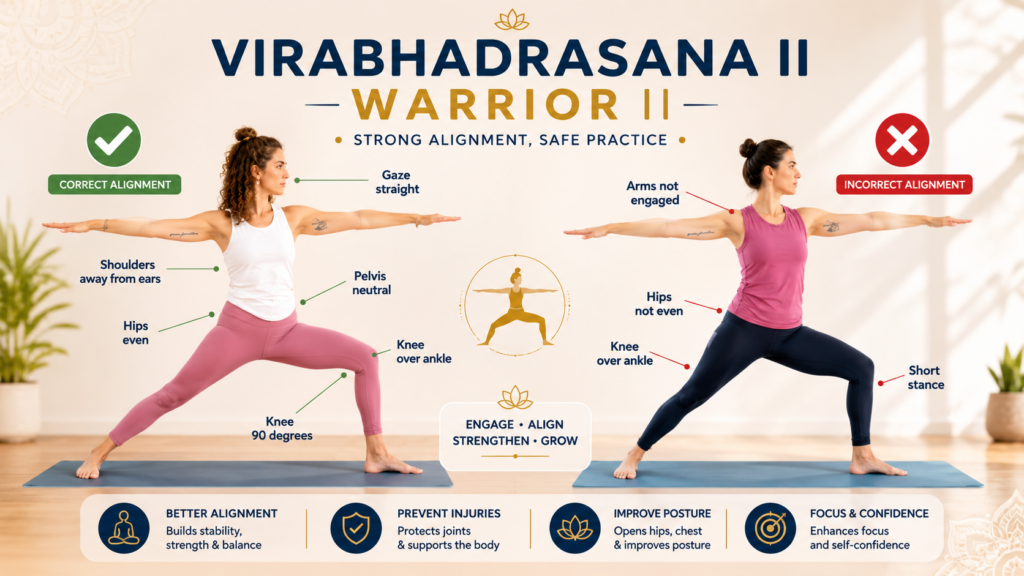
For example, in Warrior II, proper knee alignment helps protect the knee joint and improves stability through the legs.
Correct and incorrect Warrior II (Virabhadrasana II) yoga pose alignment guide for yoga teacher training and safe yoga practice
Without anatomical awareness, students may unknowingly place stress on sensitive areas.

2. Anatomy Builds Body Awareness

One of the greatest gifts of yoga is awareness.
Anatomy deepens that awareness.
During yoga teacher training, students begin noticing:
  • Which muscles activate in different poses
  • Where they hold tension
  • How breathing affects movement
  • Which habits create discomfort
This process helps future teachers develop a stronger connection with their own bodies before guiding others.
For example:
A trainee may realize they always lock their knees in standing poses or collapse into the lower back during backbends.
These small observations can completely change how they practice and teach.
Yoga Is Not One-Size-Fits-All
One of the most important lessons anatomy teaches is this:
Every body is different.
Two students may look completely different in the same pose — and both can still be practicing correctly.Lorem ipsum dolor sit amet, consectetur adipiscing elit. Ut elit tellus, luctus nec ullamcorper mattis, pulvinar dapibus leo.
Factors that affect movement include:
  • Bone structure
  • Muscle length
  • Flexibility
  • Previous injuries
  • Strength levels
  • Mobility patterns
This understanding helps yoga teachers stop forcing “perfect shapes.”
Instead, they begin teaching according to function and comfort.
That creates a more inclusive and supportive yoga environment.

3. Anatomy Helps Teachers Give Better Instructions

Clear cueing is an important teaching skill.
Anatomy helps teachers explain movement in ways students can actually understand and feel.
Instead of saying:
“Just stretch deeper.”
A teacher with anatomy knowledge may say:
  • “Engage your core to support the lower back.”
  • “Press evenly through both feet.”
  • “Relax unnecessary tension in the shoulders.”
These cues are more specific, helpful, and safer.
Students also gain more confidence when instructions feel clear and purposeful.
Understanding Common Injury Areas in Yoga
Certain body areas are more vulnerable in yoga practice.
These commonly include:
  • Knees
  • Lower back
  • Wrists
  • Neck
  • Shoulders
  • Hamstrings

A yoga teacher trained in anatomy learns how to protect these areas during practice.

For example:
Lower Back Safety
Many students experience lower back discomfort in backbends or forward folds.
Anatomy education helps teachers understand:
  • Pelvic positioning
  • Core engagement
  • Spinal movement
  • Hip mobility
This allows teachers to guide poses more safely.
Shoulder Awareness
Shoulders are highly mobile joints, which also makes them vulnerable.
In poses like Plank or Chaturanga, improper shoulder positioning can create strain over time.
Understanding anatomy helps teachers teach strength and stability, not just flexibility.


4. Anatomy Improves Hands-On Adjustments

Many yoga teacher training courses include adjustment techniques.
Without anatomical understanding, physical adjustments can become risky.
A safe adjustment should:
  • Respect joint limits
  • Avoid forcing movement
  • Support stability
  • Improve awareness
Good teachers understand that not every body should move deeper into a pose.
Sometimes the safest adjustment is simply verbal guidance or no adjustment at all.
Anatomy Helps Teachers Work With Different Students
A yoga class may include students of many ages and backgrounds.
For example:
  • Athletes
  • Office workers
  • Seniors
  • Beginners
  • Pregnant students
  • Students recovering from injuries
Each body has different needs.
Anatomy gives teachers the tools to adapt yoga safely for different populations.
This creates more confidence in real teaching situations.

5. Anatomy Encourages Smarter Sequencing

Sequencing means organizing poses in a logical and safe order.
Anatomy helps teachers understand:
  • Which muscles need warming up
  • Which poses prepare for advanced postures
  • How to balance strength and flexibility
  • When students may become fatigued
For example:
A strong backbend sequence should include:
  • Shoulder opening
  • Core activation
  • Hip preparation
  • Spinal awareness
Without preparation, students may strain the lower back.
Good sequencing protects the body while creating a better class experience.
The Connection Between Breath and Anatomy
Yoga anatomy is not only about muscles and bones.
Breathing also plays a huge role.
Understanding the diaphragm, rib cage movement, and posture helps teachers guide healthier breathing patterns.
Many people breathe shallowly because of stress or poor posture.
Breath awareness can help:
  • Reduce tension
  • Improve focus
  • Support relaxation
  • Increase energy
This is why anatomy and pranayama are often connected in yoga teacher training.

Anatomy Makes Teachers More Confident

Many new yoga teachers worry about making mistakes.
Anatomy knowledge builds confidence because teachers begin understanding why poses work, not just how they look.
This confidence helps teachers:
  • Answer student questions
  • Offer modifications
  • Teach safely
  • Adapt classes intelligently
  • Recognize limitations
Over time, anatomy becomes less about memorization and more about observation.
Teachers start seeing movement patterns naturally.

Common Misconceptions About Anatomy in Yoga

“Anatomy is too scientific for yoga.”
Actually, anatomy makes yoga more practical and accessible.  
It helps bridge ancient wisdom with modern understanding of the body.
“You need to memorize every muscle.”
No. Most yoga teacher trainings focus on practical anatomy, not medical-level memorization.
“Flexible people understand anatomy automatically.”
Flexibility does not equal body awareness.
Some very flexible students are actually at higher risk of overstretching.

How Future Yoga Teachers Can Learn Anatomy Easily

Anatomy becomes easier when connected to movement.
Helpful learning methods include:
  • Observing your body during practice
  • Learning through movement instead of memorization
  • Using simple diagrams
  • Attending anatomy workshops
  • Practicing cueing with classmates
Over time, concepts begin making sense naturally.

Frequently Asked Questions About Anatomy in Yoga Teacher Training

1. Why is anatomy important in yoga teacher training?
Anatomy helps yoga teachers understand movement, alignment, safety, and injury prevention so they can guide students responsibly.
2. Do yoga teachers need deep medical knowledge?
No. Yoga teachers need practical anatomy knowledge related to movement, posture, and safe teaching.
3. Can anatomy help prevent yoga injuries?
Yes. Understanding anatomy helps teachers recognize unsafe alignment and avoid overstretching or joint strain.
4. Is anatomy difficult to learn for beginners?
Not necessarily. When taught simply and connected to movement, anatomy becomes much easier to understand.
5. What body parts are most important in yoga anatomy?
Common focus areas include:
  • Spine
  • Shoulders
  • Hips
  • Knees
  • Core muscles
  • Breath mechanics
6. Does anatomy improve yoga teaching skills?
Absolutely. It improves cueing, sequencing, adjustments, and overall teaching confidence.

Final Thoughts

Anatomy is one of the most valuable parts of yoga teacher training because it helps teachers understand the body with greater awareness, respect, and intelligence.
Yoga is not about forcing students into perfect-looking poses. It is about helping people move safely, breathe better, and feel more connected to themselves.
When future teachers understand anatomy, they become more capable of creating classes that are safe, inclusive, and supportive for every student.
In many ways, anatomy transforms yoga teaching from imitation into true understanding.

Elevate Your Teaching: Anatomy & Alignment Module

Explore our yoga anatomy and alignment module designed for future yoga teachers. Learn body awareness, safe alignment principles, movement mechanics, and practical teaching skills through beginner-friendly training that connects modern anatomy with traditional yoga practice.
Safe Alignment Principles
Body Awareness
Movement Mechanics
Practical Teaching Skills
👉 Discover your teaching potential.

Leave a Comment

Your email address will not be published. Required fields are marked *

Scroll to Top